A modular building construction timeline in Perth usually runs in five stages: planning and approvals, factory manufacture, transport, installation and handover. So how long does it take to build a modular building? For a standard layout, manufacturing typically takes weeks and on-site installation takes days, but design and approvals come first and often set the overall pace. This guide walks through each stage for commercial, education and site projects in WA, using official approval timeframes, plus a quick modular vs traditional build time comparison.
The Modular Building Construction Timeline in Perth, Stage by Stage
Most commercial modular projects follow the same five stages, although the time spent in each varies with scope, site and approvals.
| Stage | What happens | Indicative time |
|---|---|---|
| 1. Planning, design and approvals | Design, planning approval where needed, building permit | Usually the longest and most variable |
| 2. Factory manufacture | Modules built in a controlled factory | Weeks for standard layouts |
| 3. Transport and site preparation | Heavy haulage, permits, cranage, footings | Planned alongside manufacture |
| 4. Installation | Modules positioned, joined and sealed | Days for standard layouts |
| 5. Commissioning and handover | Final works, compliance sign-off, occupancy | Depends on scope |
Stage 1: Planning, Design and Approvals
This stage usually sets the pace of the whole modular building construction timeline. Where planning approval is needed, the local government's decision timeframe is 60 days if advertising is not required and 90 days if it is. A building permit follows, and a permit authority has 10 business days to decide a certified application and 25 days for an uncertified one. These timeframes cover the decision only, so design and documentation time sit on top.
Stage 2: Factory Manufacture
Standard layouts can be manufactured in weeks, depending on scope, finishes and location. Production in a controlled factory gives better control over quality, safety and speed than an exposed site.
Stage 3: Transport and Site Preparation
Heavy haulage, permits, cranage and lift studies need planning before a module leaves the factory. For transportable site buildings heading to remote WA sites, from the Pilbara to the Goldfields, distance adds to this stage, and cyclonic-rated options are available where wind loads require them.
Stage 4: Installation
Modules typically arrive on platform trailers and are positioned by crane or hydraulic jacking, then joined, sealed and commissioned. For a standard layout, installation is typically completed in days.
Stage 5: Commissioning and Handover
Final works and compliance sign-off follow installation. A commercial or public building needs an occupancy permit before use, supported by a certificate of construction compliance from an independent building surveyor, so handover for commercial and executive buildings is planned around it.
What Is the Correct Order of Construction for a Modular Building?
In traditional construction, most work happens in sequence on site. A modular project changes the order: while the building is manufactured in the factory, footings, services and access can be prepared on site at the same time. The Modular Building Institute attributes its estimated 30 to 50 percent schedule saving to this concurrent working, though it names no underlying study.
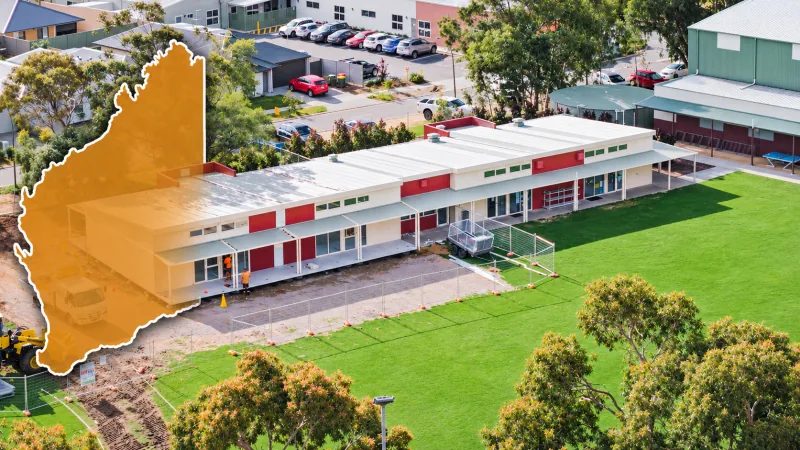
A project from Rapid Modular, Byford John Calvin School, included a two-classroom modular building with integrated concrete slab foundations, an example of the split between factory and site work.
Modular vs Traditional Build Time
The difference in modular vs traditional build time comes mainly from sequencing, not from skipping steps. Approvals, permits and compliance still apply, so the saving is concentrated in the factory and site stages. For a fuller comparison, see modular vs traditional construction.
Quick comparison:
| Factor | Modular | Traditional |
|---|---|---|
| Sequence | Factory manufacture and site preparation run at the same time | Most work follows in sequence on site |
| Overall timeline | Estimated 30 to 50 per cent shorter (industry body estimate) | The baseline |
| Time on site | Installation typically takes days for standard layouts | The full build happens on site |
| Approvals | Planning and building permits still apply | The same |
What Can Speed Up or Delay a Modular Build?
Four factors shape the modular building construction timeline:
- Approvals: planning and permit timeframes are set by the local government and permit authority.
- Scope and finishes: lead times depend on scope, finishes and location.
- Site access: remote or constrained sites need more transport planning.
- School calendar: installation for schools is scheduled around bell times, exams and school events.
Asking the right questions early also helps, and the top 10 questions to ask your modular builder covers timelines in more depth. In short, ask for the estimated timeline from factory build to site installation, what the base contract includes, and how modules are transported and connected.
To talk through scope, approvals and the modular building construction timeline for a specific project, get in touch with Rapid Modular.
Frequently Asked Questions
How long does it take to build a modular building?
Factory manufacture is typically weeks for a standard layout, and scope, finishes and location change that. Design and approvals sit alongside and are usually the longest stage of the modular building construction timeline.
Does a modular building need a building permit in WA?
As with other commercial buildings, building work that needs a permit must go through a permit authority, and commercial and public buildings need an occupancy permit before use. Builders must be registered for permit work valued at $20,000 or more in listed areas.
Can a modular classroom be installed during school holidays?
Yes. Installation is scheduled around bell times, exams and school events, and builds are often completed during school holidays. WA public school term breaks in 2027 run about two weeks, with a longer summer break from 18 December 2026 to the end of January 2027.
Does a remote WA site lengthen the modular building
construction timeline?
It can. Distance, heavy haulage permits, cranage and lift studies need more planning, so allowing for them early helps. Cyclonic-rated options are available where wind loads require them.
What are the phases of a construction project, and how do
they apply to modular?
Construction projects are commonly described as planning, design, pre-construction, construction and handover. In a modular project, the construction phase splits into factory manufacture and on-site installation, with site preparation running alongside.