Why choose modular construction for your next commercial, education or site-based project in Western Australia? Because the state's commercial, education and resource sectors are under constant pressure to deliver infrastructure faster than ever, whether that's a growing school campus, a new corporate office, or a remote worksite that needs to be operational within weeks. Traditional construction often can't keep pace with tight deadlines, remote logistics and ongoing labour shortages across the state.
This is exactly where modular construction offers a practical, provable answer. For commercial, educational and site-based projects across WA, modular delivers the speed, cost control and reduced disruption that traditional methods often struggle to match. It's a question worth answering properly before committing to any building method for your next project.
Understanding Commercial Modular Construction
What Is Modular Construction?
Modular construction is a building method where structures are manufactured in individual sections, or modules, at an offsite facility before being transported and assembled on the final site. Commercial modular buildings arrive largely complete, which reduces the amount of work required once they reach the site.
How It Works: From Factory Floor to Final Site
Every project begins with design and engineering, followed by manufacturing in a controlled factory environment while site works happen in parallel. Once complete, modules are transported and installed on site. Manufacturing for standard layouts typically takes weeks, with on-site installation in days. Actual lead times depend on scope, finishes and location across WA.
Tailored Solutions Across Key Sectors
Commercial Infrastructure: Rapid Modular designs and delivers modular offices for Perth businesses, construction companies, mining operations, industrial sites and organisations across regional WA, offering everything from permanent workplaces to temporary site offices and scalable buildings for growing teams. It's a practical option for any Perth-based organisation weighing modular offices against the cost and timeline of a traditional fit-out.
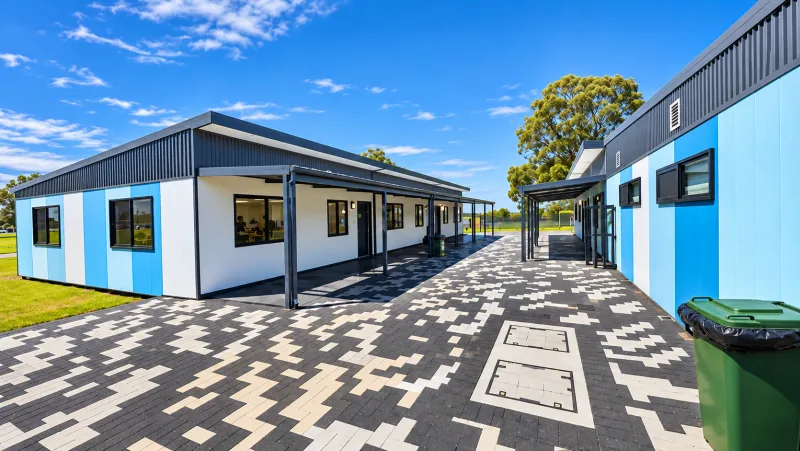
Educational Facilities: For schools, Rapid Modular provides modular classrooms, administration blocks, libraries, STEM labs, specialist learning areas, ablution blocks and staff facilities, with installation scheduled around bell times, exams and school events, and builds often completed during school holidays.
On-Site & Worksite Solutions: For construction, mining, civil, and industrial sites, Rapid Modular supplies transportable site offices, lunchrooms, ablution blocks, first-aid rooms, meeting rooms, training rooms, and storage buildings, suited to temporary, semi-permanent, or permanent use.
Modular vs. Traditional Construction for Commercial Builds
| Factor | Modular Construction | Traditional Construction |
|---|---|---|
| Site disruption | Minimal; most work happens offsite | Extended on-site presence |
| Weather risk | Reduced; manufacturing occurs in a controlled facility | Exposed to weather delays |
| Delivery approach | Parallel factory build and site prep | Sequential, on-site only |
| Flexibility | Relocatable, reconfigurable, expandable | Fixed once built |
Key Advantages of Modular for Commercial & On-Site Projects
- Faster project timelines: manufacturing and site preparation run in parallel, so commercial modular construction projects generally reach completion faster than sequential traditional builds.
- Compliance and quality control: every project is engineered in accordance with the National Construction Code (BCA) and relevant Australian Standards, including AS1428.1 for accessibility, with documentation covering planning, building permits, fire safety, and energy performance. Education projects are also designed to meet DET and AISWA requirements, giving school administrators one fewer compliance concern to manage during construction.
- Minimal on-site disruption: installation is scheduled to fit around active school terms, live commercial sites and running worksites.
- Scalability and relocation: modules can be reconfigured, expanded or relocated as enrolments, teams or site needs change.
Why Modular Is the Future of WA Infrastructure
Rapid Modular services the full breadth of Western Australia, including Perth metro, the Pilbara, Kimberley, Goldfields, Wheatbelt and South West, managing heavy haulage, pilot vehicles, permits and cranage for regional and remote sites.
As WA continues to face skilled labour shortages and tight project timelines across construction, mining and education, offsite manufacturing offers a way to keep projects moving without relying solely on an already-stretched on-site workforce.
Common Misconceptions About Modular Buildings
For anyone still weighing up whether to choose modular construction over a conventional build, much of the hesitation stems from outdated assumptions about what modular buildings actually look like and how they perform today.
Modular buildings are only temporary or low quality. In practice, transportable buildings can be used for temporary, semi-permanent or permanent applications depending on project needs, and every build is engineered to the same National Construction Code and Australian Standards as a traditional structure, not a lesser, stripped-down version of one.
Design options are limited. Modular buildings can be reconfigured, expanded, or tailored to suit a specific campus, business, or site, from a single classroom to a full learning precinct, or from a single office to a scalable workspace.
Partner with Rapid Modular for Your Next Project
Whether you need commercial modular buildings for a growing business, a new classroom block, or a site office for your next project, Rapid Modular delivers WA-built modular solutions engineered for speed, compliance and minimal disruption, backed by a fully managed process from planning through to installation. If you're still deciding why to choose modular construction for your next build, talking through your project with a team that delivers all three sectors is the fastest way to find out.
Ready to build something better? Request a quote and let's talk about your project.
Frequently Asked Questions
What types of commercial projects benefit most from modular
construction?
Commercial projects with repetitive layouts, strict deadlines, and a strong need for parallel off‑site fabrication and on‑site preparation benefit the most from modular construction. Office fit‑outs, executive workspaces, and scalable modular offices for growing teams gain from faster delivery and flexible layouts, making modular construction an ideal solution.
How does modular construction minimise disruption to active
school campuses or operating sites?
Modular construction minimises disruption by shifting up to 90% of work off‑site, reducing noise, dust, and traffic. On‑site crews spend weeks rather than months, working in safer, smaller work zones. Entire classrooms or buildings can be installed during school breaks, ensuring students return to ready‑to‑use spaces.
Can Rapid Modular facilities be expanded or relocated in the
future?
Yes. At Rapid Modular, our facilities are designed for flexibility; modules can be reconfigured, expanded, or relocated as enrolments, teams, or site needs evolve. This adaptability ensures long‑term usability while reducing delays and costs associated with traditional construction.
Is modular construction cheaper than traditional
construction?
Costs vary by project scope, but modular's controlled factory process and transparent pricing model help avoid the cost blowouts often caused by weather delays and on-site labour shortages in traditional builds.